Monday, 17 February 2014

LO1: Analysis/Review #5 - Bio-hazard Battle

Platform: Sega Genesis/Mega Drive

Genre
- Bio-hazard Battle is an auto side scrolling Shoot 'em up game that takes a different spin on a genre that was extremely popular at the time, combining both action and science fiction to create a fresh little concept for a fun but challenging game. Much like other games in the genre the entire game revolves around the idea that you'll go through various levels and take down as many enemies as you can, hence the name, whilst trying to accumulate as many points as possible and ultimately stay alive. You can collect power ups and extra lives if you're lucky enough to find them, but the meat of the game will always boil down to how good you are with your reaction times, whether it be to gun down an approaching enemy or to dodge incoming projectiles. It's well known that these games were ruthless and unforgiving, so the only way to beat this game is through sheer perseverance alone. To be honest it stands out pretty well from the other games of this genre, it has an interesting storyline which obviously had a lot of thought put into it, and whilst the level designs aren't exactly anything new with how most of them are linear, the backgrounds, the enemies and everything else are imaginative enough to get your attention and the action is great and the controls are tight. It's also a refreshing change to play as something living within a Shoot 'em up rather than taking control of a machine instead, fighting fire with fire, if you will, to take back your home world. It has a certain charm about it, but that may only apply to me because this game was... well, my childhood, really. Me and my brothers used to play this game for hours when we were younger, and even today I get all warm and fuzzy inside just thinking about it.


Narrative
- There's no in-game explanation of the story, so you better have the manual on hand if you want to know why the hell you're playing as a living ship gunning down numerous alien critters that are out for blood. Turns out during the very first bio-war one of these sides used a retro virus in retaliation which in turn unleashed waves of biological weapons which couldn't be stopped, and now your planet, Avaron, is inhabited by monsters of all shape and sizes, but all of them are equally as deadly. The space station O.P Odysseus remains in orbit around the planet which houses the very last of the survivors, frozen in cyrogenic tanks for hundreds of years, until finally they are awakened after so long of being inanimate. Avaron is dangerous, but certainly not uninhabitable. You will now take control of one of the crew members who descends down to the planets surface and through various locations and habitats on Avalon to cleanse them of any creatures living there in order to make it a new, safe home for the remaining survivors. According to the manual this mission takes place in the year 2116, or at least close to that. The only interaction you'll get with the 'characters' in regards to this story is controlling whichever ship you decided to pick through each of these levels, though I suppose if you consider the enemies prominent enough to be classified as characters within this game then your interaction with them would be to blast every single last one of them into smithereens. It also helps that the target audience probably expected that coming from a game like this, I don't think many people would buy it without knowing what they were getting themselves into. Those unfortunate enough to make that mistake... well, the odds were against you from the very start.


Production Process
- It's pretty common by now to know that when a game is ported over to a different console there's going to be some changes, but the same can also be said for games which aren't ported over to different consoles and are instead changed depending on what country they're released in. Regional differences are nothing new when it comes to video games and it turns out this particular one wasn't left out, either. Crying: Aseimei Sensou is the title that the Japanese version of this game holds. Aside from the obvious name change the differences between the two games are minimal at best, yet they're noticeable if you pay close attention to them. I went through and tried to pick out the details and changes that stood out the most to me whilst playing through the game, it's entirely possible that I missed a few things along the way but, hey, I tried my best. Just to note with these pictorial lists the Bio-hazard screenshot will be on the left of the Crying screenshot which will be on the right. With that being said, let's get on with it.


Nothing extremely major to report here, other than the fact that the TM perched at the end of SEGA there is absent from Crying. The entire SEGA entry has it's own animation, too, where it curves in off screen, so it makes you wonder why they even bothered to remove it/add it in there. I'm not sure why this was changed but, it's there all right.


Probably the most major change that this game is given is the title screen to correspond with the name of the game. Crying certainly cranked it up a notch in terms of design, even as the title fades in we get a little animation of the bio-hazard symbol fading in from black and moving over to the left before the rest of the title comes into view, with the blue background being slightly wavy before it settles down. Bio-hazard Battle's title screen simply fades in, and that's that. The copyright and release date are still in the exact same place and the font style is the same, too. Let's also not forget the box art, shall we?
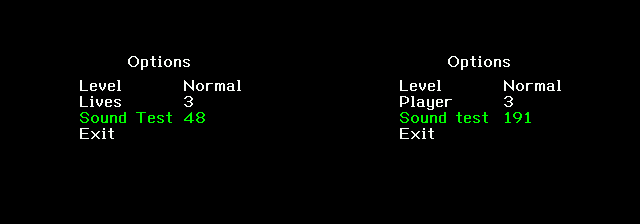

I had to go lurking around the menus for any differences, just so I could be sure I didn't miss anything. All of the ship graphics are the same on one player mode as well as the two player mode, even the red and blue cursor highlights are there. The font is the same as well. In the options mode both games have the five difficulty settings even though the difficulty in game is still different and there's no alteration in the number of lives either, having three, four or five to start with. One thing that has changed is that Lives has been replaced with Player in Crying. There's also the sound test. The maximum that Bio-hazard Battle goes up to is 48, whereas the maximum that Crying goes up to is 191.


It's not exactly noticeable at first glance, and trust me, I missed it my first time through, but Crying added the letters P, T and S at the end of your point total. You can probably guess what it stands for. A small change, yeah, but it's still a difference nonetheless. It may also be worth mentioning that in the first level in particular I noticed that the background scrolled an awful lot slower in Crying than it did in Bio-hazard Battle as you go down from space to enter the planet's atmosphere. Again, I'm not sure why this is, but it's just another to add to the list.


Full stops after the clarification that you beat a stage. Why not?


Enemy projectiles. I noticed this one straight away and you'll more than likely notice it too with how many there are this time around. Think it's bad in Bio-hazard Battle? Try Crying. It's a fitting name, because that's exactly what you'll be doing by the time you're done with this game. Even on normal difficulty the projectiles seem to have increased, not to mention I'm pretty sure some enemies have doubled in number as well. Enemies that don't seem to fire off any sort of projectile in Bio-hazard Battle do so in Crying. A lot. Have fun.

Characterisation
- Considering the genre of the game players would most probably like to have a character which can at least take a few hits, but this game is not one of said games. At least they make up for it with enemies that take one hit to kill and are sparing with most enemies that do take multiple shots to obliterate, though you'll see more of them along the way with bosses and with how the game progressively gets harder, as if it isn't hard enough. At least your character can dispatch of enemies quickly with your normal projectiles or a charged up shot, as well as the numerous power ups you can collect, so it's nice to know you're not being thrown into this without a fighting chance. Fans of Shoot 'em ups may even like the new abilities that these bio-ships have that they can play around with. With most of these sorts of games the character is mainly just an avatar in which you can place yourself into their shoes, especially in this game when no other detail of the pilot is mentioned apart from the storyline and the manual consistently refers to the player in a way which makes it seem like you're the one taking control of the ship, and you're the one who everyone is counting on to save the day. There's no actual development with these characters that I know of, they're certainly strong in their offense (maybe not so much defense) but personality wise there's nothing considering it's basically you in the drivers seat and these ships are nothing more than that, despite the fact that they're actual living things mixed with machine, which could be an excuse as to why they're void of any personification. They seem adequately equipped to deal with the atmosphere of the planet too, and the manual even says that the reason why you're constantly under attack is because the energy given off by your ship is what attracts them to you. If you do play this game to the extent that I did you may find yourself choosing a certain ship every time you boot it up to play. Every ship is different in it's own way and it gives a little bit of variety and experimentation before you figure out which one is best for you. The red and blue saw-shark like ship is called Orestes, being one of the fastest ships in the game along with Hecuba, modelled after a giant green insect. The other two ships, Electra, the red and green plated creature and Polyxena, my favourite, a gold and purple dolphin like being, are more easy to control, but in return it's harder to get out of the way and react to everything that's coming your way. Upon picking up a yellow energy seed both Orestes and Electra will equip what's known as a Fire Petal, a stream of white-hot fireballs, whereas Hecuba and Polyxena will equip a Spin Laser, twin lasers that rotate. An orange energy seed will give Orestes and Hecuba a Plasma Ring, which bounces off inert matter before exploding upon contact with living tissue, and Electra and Polyxena will gain a Seeker Laser, a red beam that homes in on enemies. Bond (globes of plasma which latch onto creatures and detonate) will be given to Electra and Hecuba upon picking up a blue energy seed and Nova (bursts of energy that travel all over) will be passed onto Orestes and Polyxena. Lastly there's green energy seeds, where all four ships will gain a power up known as Pods, which happens to be the default weapon for the Power Star, that little thing that follows your ship around. These seeds apparently change the genetic structure of the bio-ship, allowing it to fire off all these crazy projectiles.


Gameplay
- In typical Shoot 'em up style your ship will auto scroll through any and all the levels whilst you shoot down various enemies that attempt to destroy you. It sounds extremely simple, and it is, but staying alive... not so much. These creatures are ruthless and come from all directions, stopping for a split second is basically the equivalent of saying 'kill me' and you have to stay on your toes. The challenge in this game is insane. You start off with a default of three lives and ten continues but you'll go through them in the blink of an eye, considering this is one of those games that uses the one hit kill rule and the enemy placement is so clever in the sense that if you dodge something that would surely kill you, chances are you'll run into something else you didn't even see. This game honestly forces you to multitask and you better get used to it if you have any intention of beating this game, me and my brother have only ever managed to beat this game once and that was a long, long time ago. In terms of attacking you can manually fire, auto fire or build up your charge to unleash it as a plasma wall. There are also energy seeds which act as your secondary fire and collecting more of the same colour boosts it up, and the weapons slightly vary for each character you can play as, from homing lasers to projectiles fired off in a star like pattern. The gameplay doesn't exactly change in any way but the game always throws something your way to keep your attention. Extra lives are gained when a select number of points are obtained and you can also find them scattered around some levels, but don't expect there to be a lot of them. Did I forget to mention you can bring in a second player to help you? Nothing like sitting down with a friend or a family member and torturing yourself with a tough-as-nails game that makes you want to claw out your eyes after seeing that death animation a hundred times. Ahh, memories. Do also note that playing on Practice difficulty does not let you play the last three levels, so you're gonna have to get better at this game before you attempt to finish it fully.

As your selected ship is launched from the O.P Odysseus you will now have to guide them through eight levels in order to restore peace to Avaron, the very first of them being your re-entry into the planet's atmosphere. Don't worry, the incredible heat generated by this has no adverse effect on your ship. Flying creatures from flies to squids will attempt you fend you away from their current home planet, so watch out. The second stage is set in the ruins of a once bustling metropolis, now reduced to rubble, but the computers within the city are still active and many robotic obstacles will stand in your way to take you down. This stage introduces the first boss of the game, a giant slug like creature with a mirrored pillar on it's back. Yeah. Bosses. As if you didn't get the shit kicked out of you enough during the stage, now you have to go up against some massive monstrosity that'll go through your remaining lives faster than you could throw the game cartridge out the window in a blind rage. The third stage takes place within the humid jungles that the manual refers to as being in Asia... either Avaron is a renamed earth or this planet so happens to have a country with the same name, but in either case you'll have to get through this mess of insects and other beasties that fly all over the screen to reach the end, where you'll face off against a serpent-like being covered in flesh and bone. Moving on to stage four it seems that this particular cave, or Bauxite Mine as it's called, isn't one of the places spared from the nasty creatures that dwell within. You'll have room to maneuvor but you're not going to get out of there unscathed. The boss of this level is a rather strange looking shrimp which uses the slime on the walls of the overrun mine to cover itself in armour, and only by destroying it will you be able to harm it's occupant. Stage five drops us down deep into the ocean, with fish, urchins, mantis shrimps, jellyfish and whole other variety of sea enemies attempting to send you to a watery grave. To finish off this stage you'll have to take on a hybrid of manta ray, barracuda and angler fish all rolled into one big ball of oceanic rage that can apparently fire lasers out of it's mouth. Awesome. Stage six? Even more awesome. This has to be my favourite level of the entire game because it makes a huge difference from the cluttered mess of the other levels with the open sky and the clouds whizzing past your ship. It turns out that an automated warjet, once used in the first biowar, has seemingly reactivated, and is now patrolling the sky, capable of destroying any colony that you've now cleared the way for back in the earlier levels with it's immense power. The whole stage is now based around taking down this massive ship and once you destroy the first part of it's defenses you'll realise why this retired ship has risen once more as the wreckage breaks away: the entire interior of the ship has been taken over by a biological growth. It's actually quite terrifying that this problem has got to the point where these creatures are smart enough to control a huge warjet but at least it makes for an amazing boss fight as you chip away at the outer shell to expose the core. Inside the very lab that created these hazards (of the biological kind) is where stage seven will take place. It won't be easy as the defense mechanisms are still in place, and trust me, there are monsters everywhere. To say the least the boss of this stage is... interesting? I think? I can't even make out what they are, they seem to be grey shapes of some unknown entity that swarm around you and... that's pretty much it. It's one of the weaker bosses in the game, honestly, but the weakest one is the final boss. Yeah. After going through the toughest level possible, sacrificing your remaining lives to get to the end of the stage and finally see the last boss they throw some... orb like thing at you. Granted it is pretty cool that when you defeat it it's shell breaks open and a ton of creatures pour of out it, plus it's also pretty neat to see it have a second form which is even harder, but in a game that's entitled Bio-hazard Battle I was expecting something living for the final boss. I can't gripe too much considering it's still a good final fight but, it's a tiny bit underwhelming in my opinion. The ending probably doesn't make up for all the cheap deaths and rage-quits but, when you take into account you just beat one of the hardest games you'll probably play in your life, it makes it a whole lot better. The ending also leaves it ambiguously open for a sequel, but one was never made.


Target Audience
- I'd say the target audience for this game would mainly be boys, more than likely young ones too who would have had an awful lot of time to spare in order to beat this game. I'm pretty sure the only reason as to why I played this game initially was because it was bought for my brothers, and since I was constantly around them when I was younger we ended up playing this a ton, sparking my love for it. It may very well be the one game that got me into gaming itself, knowing I played games a ton back then and I still do now, it really wouldn't surprise me. Let's also not forget that this game was obviously intended for those who are fans of the Shoot 'em up genre, if you know what those games are like and you do enjoy playing them chances are you're going to be pretty good at them. This games offers a huge variety of weapons to mess around with and different ships to play as with multiple difficulty options as well, so there's a ton of combinations to try out which will make any fan satisfied. It's appealing because it's both old and new at the same time. The gameplay isn't any different from others in the same genre. Move right and shoot. Wow. However, the premise, the story, the ships, the enemies, the levels, the power ups, the actual lore carried through the manual and everything else makes this stand out so much more from it's competitors, and it does compare pretty well to others, but sadly it was under the radar, so to speak. It was overshadowed by a ton of games and it seems pretty unknown to most people, but that's alright. It'll always have a special little place in my heart.


Platform
- The game was originally made on the Sega Genesis/Mega Drive in 1992 but was ported over to the Nintendo Wii's Virtual Console in 2007. It was also released on Steam in 2010, leading the total platforms that this game can be played on up to three, but none of them would ever live up to the feeling of playing the game on that old Sega console, the one it was best suited to. You can control whichever ship you chose by pressing the D-Pad in any of the eight directions available, the A button is used for firing off projectiles and the B button is used for charging up one huge, powerful shot should you hold it down for long enough before letting go. Pressing Start will allow you to pause the game. A also is used for selecting options on the menu and B is used for going back or cancelling things. The D-Pad in this menu state is used to move and highlight what you want to alter, as well as pressing left or right respectively will change the options available should you end up selecting it. You also use the D-Pad to highlight your character. There is no way to configure your controls in the options menu, but you can change things such as the difficulty, the number of starting lives you have or, interestingly enough, you can mess around with the sound test. Normally sound tests are things you have to unlock or use a code to get to, but here it's just sitting there for you to mess about with. Most of them are just normal sounds you hear through the game, but if you've ever wanted to sit there and listen to the music in a stage without the constant sound of you dying distracting from it all, you can do so here. Unless you're totally masochistic I advise you to turn your difficulty down to Practice or Easy and pump up the number of lives until you eventually get used to how evil this shoot 'em up can be. Good look beating the game. You'll need it.

Thursday, 6 February 2014

LO1: Analysis/Review #4 - Monster Party

Platform: NES


Genre
- Monster Party is a side scrolling adventure game which also acts as a platformer, with themes of horror and comedy thrown into the mix. It acts more of a parody of sorts to the former genre and is quite cartoony and interesting within it's design, giving the game a very unique charm. Much like other games Monster Party progresses through the storyline by moving the main character to the right in various levels, with the exception of one in which you have to ascend the level vertically, with the simple actions of jumping into the air and swinging your bat around being the only means of offense that you have at your disposal. In comparison to all the other NES side scroller games (trust me, there was a lot of them) it doesn't exactly stand out as much as some of the other, more popular ones, but it does stand out in the sense that this game is really strange. It's just weird. It has a bizarre sense of humour and the designs are quirky at best, especially when it comes down to the bosses. The dialogue is very lax and not exactly serious, which only further pushes and reinforces the parody label that this game has been granted. Another thing to note in this game is the use of blood. Whilst it's tame by today's standard back then this was probably the goriest NES game out there, even though it's depicted in this goofy sort of style. A pretty good example of this would be the round start screen, which shows six skeletons and hands rising up from a lake of blood as it drips down from the backdrop as well, it's over the top and cheesy, sure, but they certainly were not afraid to put it in there, and many more things within the game are on par with this balance between slightly offsetting and laughably excessive.


Narrative
- The story told in this game is that our young protagonist, Mark, was walking home from a baseball game when he looked up a saw a shining star. The star wasn't really a star at all, it was in fact, a monster, that fell from the sky and landed in front of him. It turns out this friendly creature goes by the name of Bert, and has come to Mark's world in order to find help in ridding his home land of the evil beasts that have taken over. Apparently Mark makes a good candidate considering he has a baseball bat, and Bert flies off with his newfound ally back to his world to begin their adventure. It's dangerous, Bert warns him, and the two of them fuse together. You read that last part right. Whilst the story isn't exactly the most gripping narrative of all time it at least sets up the criteria for the rest of the game, which involves going through every level and attempting to rid it of the bosses that are hiding within several doors scattered throughout the stage. The only interaction you really have with Bert is that certain enemies drop a pill which will transform you into your other half for a brief period of time. During this phase you can fly by repeatedly pressing the jump button and fire off projectiles using the attack button. Considering a lot of NES side scroller games don't have an in game explanation of the story (more than likely due to memory limitations) it's nice to actually see one kept through this game, including the opening cutscene, the dialogue of the final boss and the ending itself, which is actually sort of ambiguous and left on a cliff hanger. It has enough bat swings to keep anyone who wants a good adventure game entertained and just enough challenge to give a fair experience when playing. The story only really connects with the target audience by giving them a purpose to fulfil, plus I think the actual explanation of the story initially before the game begins will entice the player to complete the game to see what the ending will be like.


Production Process
- Bandai produced and released this game for the system in 1989, and even though the game was developed and made in Japan, it was exclusively released in the US. I'm not entirely sure why this happened or what the reasoning behind this was, but all I know is that this game was never released in Japan on their own Famicom system. Something to note with this is that one of the bosses, a haunted wishing well deep into Round 2 that attacks using plates, is based on a ghost story in Japan known as the Bancho Sarayashiki. No one outside of Japan would be all that familiar with the story to recognise the boss straight away. Several screenshots of the Beta version of the game can be seen online, and through these screenshots the game was discovered to be initially a lot more morbid and darker compared to the light-hearted game that the US got. The title screen didn't have the green slime, and was instead blood dripping from the creature's mouth, and the enemies were designed to be a lot more frightening. Rather than being a slightly odd background in the first level the original concept for it was to be a sunset with a mountain range in the background. The plant boss was also a lot different. Instead of being a purple pitcher plant the flora was originally what resembled a venus fly trap, with a microphone in front of it and a speaker behind it. This boss would attack by firing off projectiles in the shape of a musical note, and the whole set up was inspired and obviously is a reference to the Little Shop of Horrors. In the present game the collision detection for the speaker was actually never removed. If you beat the plant boss and jump to the right of the pot it once stood in you can intentionally stand on the air where the speaker should have been. Eventually a Japanese prototype was discovered of a game that was originally intended for the Famicom known as Parody World: Monster Party. I could be wrong on this, but this version seems to have things in common with the final release, such as the odd background, music and original tile sets in the first round, but it also has elements from the Beta version, such as the bloody title screen and the plant boss. The pumpkin boss was changed to become a reference to Planet of the Apes, being replaced by one of the primates on a horse with a broken version of the liberty statue in the background. With so little information around about this rather curious, obscure game and the history behind it, I really can't say for definite what I wrote up there about Parody World is true. The only reliable source of information I have for that version is this video here of someone who managed to get their hands on it, which is rather interesting to watch. There's also this video too, from the person who originally sold the prototype online showing the working game. Savour them. It's probably the only information you're going to get about this secretive little game.

 Characterisation
- Really the characters are only relevant to the target audience because it fits the natural conventions of this genre, in which there's typically a hero, Mark, or heroes, in the case of Mark and Bert, who go up against an enemy, the Dark World master, and fight his various minions, which are both the enemies and bosses in game. Mark is appealing to the target audience simply because he's capable of taking out enemies and bosses and can suffer a few hits before going down, and he's easy to control, which are things that are pretty essential to a game genre like this. Apart from the opening and end cutscenes, Mark and Bert are really just static characters for you to control, to be truthfully honest they're not exactly that interesting, with the only exception being Bert regarding the final cutscene. It's probably sort of bad that I find the boss characters, or guardians as they're called, more interesting than the protagonists themselves. They don't do much other than pose a threat, mind you, but they just seem so... interesting. I can't really describe it. Every one of them is completely different and they usually say something extremely corny before the battle starts. I've been called 'baby' three times now by a plant, a giant tempura shrimp and a dragon respectively, along with being told to 'Mooove it!' by a green minotaur. "Please don't pick on me" says the pumpkin ghost that almost immediately proceeds to attack me thereafter. Let's also not forget that the corpse of a red, bloated lizard says 'Sorry, I'm dead' as you enter the room and the only way to defeat a pair of dancing zombies is to watch them prance around until they disintegrate and disappear as you presumably sit there confused. Or amused. Or both. There's also a spider which, although it's nothing special, made me laugh. When you find him he'll remark that he'll 'suck all your blood' and proceed to attack you. Then, later on in the game, you'll find him again. Apparently he thought he won last time around, as he says he'll 'suck all your blood again'. I think the reason as to why I love these bosses so much is because they make up a big portion of the game, and they're so silly and fun to fight as well but they also provide a considerable challenge to players. They make it so that you want to know what you'll be going up against next, because if it's as crazy as the last boss you fought, you're in for a fun time.

Gameplay
- As mentioned before the gameplay for Monster Party is extremely simple. You move from left to right along what are known as Rounds and kill enemies and face off against bosses. The only real reason for beating the bosses is because you need to find a key which will unlock the door at the end of the Round, and you'll only acquire said key if you eliminate them all. NES games were a little unforgiving back in the day and they still are now, but the challenge, if you can adjust to it, isn't so bad in the beginning of the game, and like most games the difficulty curve slowly progresses the further you progress into it. It engages the player because they have to keep on their toes and get better as the game goes along, getting used to the controls and enemy mechanics and finding out ways to get around the various hazards within the levels or finding an easier way to kill a troublesome boss. The typical idea of going around beating up any enemy in sight and fighting bosses is normal for any game, really, but it's simple and easy enough to pick up on in this game that it really does help it in the long run. It's not a masterpiece by any means, but it's definitely fun enough, although it can get a little repetitive and annoying at times. At least we understand why we're going around beating the living daylights out of any creature with our bat thanks to the introduction of the story, but it's not mentioned or referred to ever again until the end of the game. Whilst most levels are the same it always seems to offer some sort of variation to at least get your attention, but in terms of variety is not exactly that broad of a subject. I guess the console's limitations could be partially to blame for this, but it's down to the creators as well.

Round 1 introduces us to the fact that the world is changing when you pass by what's known as a haniwa (a statue often buried with the dead in Japanese culture) as the screen flickers and everything becomes suddenly dark and gloomy, including the music, enemies and the entire tileset itself. You'll find guys on fire and people stuck in the ground here in terms of enemies, but eyeballs and dogs with human faces will appear as soon as the level shifts. Round 2 is a dungeon, although it looks more like a sewer, and this introduces ladders into the game in which you'll need to use to get to higher platforms, presumably to reach boss doors. It's also worthy to note that this is the level in which they throw the tempura shrimp at you in a boss battle entitled Shrimp Attack, where the shrimp will turn into an onion ring and a shish kabob upon taking enough damage. They don't really wait to throw you into the madness, do they? Round 3 takes place inside a cavern whilst Round 4 takes place within what is described as castle ruins, although the interior of the place is decorated with Egyptian themed murals and hieroglyphics. Round 5 is surprisingly peaceful, having only two bosses and one of them you don't even have to fight (lookin' at you, dancing zombies), which is a nice break from the other levels, but Round 6... just, no. It's a haunted house. Alright. It's a maze. Not alright. Mazes can work in games, don't get me wrong, but this one fails in every aspect and is a blemish on an otherwise decent little game. There's no hints whatsoever and you won't have any indication to where you are if you do get lost, and you will, trust me, and end up running in circles for ages and will probably die several times before you even realise where you have to go. It doesn't help that every room looks the same with all the floors and walls being purple in colour and every door is alike, boring and grey, with the exception of the last one, which is blue. The enemies in this stage are seemingly ten times more annoying than usual, with furniture that flies all over the place, sentient pants and drops of plasma or wisps or whatever they are will often fire from the top of the screen and home in on you. Maybe it's the enemy placement going on there, or maybe it's because you've had enough of hearing that awful music play over and over again. It's literally a never ending two second loop of 'ooOOOoo' and the worst part is that every time you enter a door it pauses before starting over. I'd say it's a bad thing because you're hearing the same bit of music over and over again, but it really doesn't help when the entire music track is a two second loop in itself. The only saving grace to this level is that it only has one boss and it's actually pretty cool. The boss room is covered in a mess of bleeding green faces and there are four heads that blend in with the background, and you have to hit the real one to kill it.

Thankfully Round 7 changes it up a bit as you climb the level vertically, but it's not without it's own problems, too, showcasing a rather major glitch. In this level you have three bosses to fight, but to get the key you only have to kill two of them. Killing the third boss takes the key away and renders the game unwinnable because you can't get through the door at the end of the round. It can especially take new players by surprise and can be equally infuriating as well. Round 8, luckily, is the last level in the game, and is fairly straight forward. Just be sure to go immediately left of the spawn point, since the game designers deliberately hid one of the boss rooms back there. After that you fight the Dark World master, and then the game is over.


Target Audience
- I'd say that the target audience for this game was mainly male centric, considering both game consoles and the actual games themselves around the time when this game came out were catered more towards boys with their content and advertising. It can also appeal to anyone who likes these sorts of games and to anyone who likes horror respectively. Mentioning it again, this game was released exclusively in the US. I'm not exactly sure it counts as a target audience though, since it's a pretty broad area of reach.


Platform
- The only platform that this game is available for would be the NES system. It's not suited to any other device and as such only uses one simple control scheme. The A button is used for jumping and the B button is used for attacking, whilst both can be used at the same time to simultaneously do a jumping attack, where Mark will swing his bat in mid-air. The left and right directional buttons on the D-Pad move Mark in that respective direction and pressing down will allow Mark to crouch, or, rather, lay, on the ground. If you also move Mark whilst in this mode you can essentially 'crawl' on the floor, although it looks like you're more so humping the ground and many entertaining moments have come from this animation alone. Pressing up causes Mark to either climb up a ladder or enter a door. Start pauses the game, and select doesn't do anything.


LO1: Analysis/Review #3 - Jurassic Park: Operation Genesis

Platform: PC


Genre
- Jurassic Park: Operation Genesis falls under the category of being a construction and management simulation game as well as a tycoon game in genre, being made in the three dimensional plane with the help of models to produce a whole new lost world to mess around with. Like many other games of it's genre the game runs in real time as you look down from above to manage your own park as you build it from the ground up, working your way from a tiny, not so successful park to the five star attraction that Jurassic Park should have been in the first place, you'll have to manage your money and make quick decisions to events and disasters that happen all over the place, but in the end, it's always worth it. Considering it's nothing amazing by concept the game itself stands out pretty well from the other games that so happened to be competing against it at the time, for one thing they didn't stick Tycoon on the end of their name, thankfully, but they also decided to focus on a subject that a lot of people would surely love. Building your own Jurassic Park. Think back to when you first watched Jurassic Park. Ever tried to imagine what it would be like if nothing went wrong, and the park worked perfectly fine? I'm sure you did. Which is why, by the time this game came out, it was something every fan of the movie would have thought of at least once, and the possibility of seeing that become a reality, not to mention by the hands of you, made everyone all the more excited to play it. I know I was, considering I spent so many hours of my childhood on this game, albeit being on the PlayStation 2, rather than the PC. They also added in a ton of new features and things to do relevant to the movie it was based on, but we'll get to that later.


Narrative
-  I'd talk about any sort of storyline here, but to be honest there just isn't one present in this game, it's more so that you play as yourself, having been hired by InGen, in high hopes that you can create and maintain a successful park. As a self insert the game does a good job with creating that sense of atmosphere, relying on in game tutorials, reports, text and voice acting to create that feeling of immersion by referring to you as... well, you. With the lack of narrative that you would normally have to stick close to you now have total freedom to do whatever it takes to create the park of your dreams, but if you think you're going to get off scott free when you demolish the fence to the Velociraptor pen to unleash a horde of the ruthless carnivores onto the defenceless visitors of your 'perfect' park, think again. You don't have a story, true, but the characters that are there within the game serve as either helpful co-workers or minor annoyances depending on which way you want to play god. You're going to interact with them either way, storyline or none, and how you do so is entirely up to you. Considering this is your time to shine the story will only ever connect to you personally through the fact that it's yours to make up, and everyone's fate rests in your hands. You can be the best park builder the world has ever seen or you can let everything fall into ruin as every dinosaur you own breaks free of their pens, either devouring or trampling your guests to death as you sit there and giggle in delight. Your choice. 


Production Process
- The game was made using an engine by the name of TOSHI, which is a sixth generation cross platform game engine. The engine was actually made by Blue Tongue Entertainment themselves, who were also the makers of the game. Obviously in developing a game things are going to be implemented and things are going to be removed before we see the final product, and interestingly enough Jurassic Park: Operation Genesis was meant to have more dinosaurs than the twenty four species that they included within the game. In an interview Blue Tongue said they originally were wanting to add in forty dinosaur species, but this was cut thanks to the console versions. If you take a look at the game's data, only on PC, mind, you can see they didn't remove the names from some of the files, as in the Eng locale you can still see some species listed within the rest of the lines. In the final version of the game, the list of dinosaurs we could hatch were as followed:

Acrocanthosaurus, Albertosaurus, Ankylosaurus, Brachiosaurus, Camarasaurus
Carcharodontosaurus, Ceratosaurus, Corythosaurus, Dilophosaurus, Dryosaurus
Edmontosaurus, Gallimimus, Homalocephale, Kentrosaurus, Ouranosaurus
Pachycephalosaurus, Parasaurolophus, Spinosaurus, Stegosaurus, Styracosaurus
Torosaurus, Triceratops, Tyrannosaurus, Velociraptor

 Taking a look at the files, the one's that were cut from the game were these:

 Alioramus, Apatosaurus, Baryonyx, Deinonychus, Diplodocus,
Iguanadon, Maiasaura, Ornithomimus, Panoplosaurus,
Tenontosaurus, Thescelosaurus, Wuerhosaurus, Yangchuanosaurus

And, with one last thing to add, the only dinosaur on the above list to actually begin development into the game was the Iguanodon. Going back to the Data folder again, if you take a look into the Unit folder you'll notice that there are several files entitled as shorter, almost nickname like aliases for dinosaurs, such as Homalo/Homalo.inx/Homalo.nwt for Homalocephale, or Alberto/Alberto.inx/Alberto.nwt for Albertosaurus. Have a look at the files beginning with I. Yup. Iguan and Iguan.nwt. No .inx file though, but those two files contain the parameters for that particular dinosaur. Pretty neat.


Characterisation
- The characters within the game are obviously relevant to the target audience, if they so happen to be fans of Jurassic Park, and you'll see a few familiar faces within this game. John Hammond returns as the CEO of Jurassic Park, who will often contact you throughout the game to report on your performance and park ratings. Alan Grant manages the fossil hunts as the chief palaeontologist that he is, and will notify you whenever the fossil market is restocked or new fossils come in thanks to your dig teams out on the field. Ellie Sattler takes the role of the parks dinosaur manager and will only really contact you if one of your dinosaurs health changes, such as it becoming comatose, sick, or dead. Henry Wu as the lead geneticist is in charge of both the research department and extracting DNA from fossils for your dinosaurs, and Robert Muldoon remains the cautious man as he is, being the park warden and warning you whenever a security breach of some kind is made, usually thanks to a rampaging dinosaur or similar causes. Peter Ludlow is now the financial director and InGen and Ray Arnold is back as a park administrator. The only character that wasn't in either the film or novel of some kind is the public relations manager Jane Powers, but she fits well enough into the atmosphere to make her a believable character. Obviously the game takes it's own spin on the story and neither the film nor game are connected, considering a lot of the characters are either completely different to their film counterparts or, more importantly, they're not dead. Another thing to note is the voice acting, whilst it's not exactly the same if you listen close enough they sound a lot like the people they're portraying, which is impressive to say the least. These characters are pretty strong in my opinion to carry over the personalities from the film and alter them to fit an new criteria, and the fact that they're being helpful is sort of expected in a genre like this.


Gameplay
- Dream it. Build it. Survive it. That's how the tagline goes to this game, and I don't think it could have been any more spot on than that. Despite how simple the game seems just by saying the objective out loud it isn't going to be that easy, and the more your park grows and expands the more challenging it is to maintain. The more you unlock and the more you gain is simply more things you have to pay attention to, but if you keep on top of everything, research items, extract genomes and actually look at your messages rather than sighing at the tenth repeat of 'urgent message from the park administrator', you'll be fine. No pain, no gain. I don't think there was a single moment in the entire time I played this game that I could sit back and think that there's nothing for me to do, the game is always throwing things your way and it forces you to multitask, unless you want all your hard work to slowly fall apart. As I mentioned above, you have to research items. It's a must. The second your current topic is finished you have to choose another and get through them all as quickly as you can considering the game likes to show little to no mercy in the things it hurls in your direction, and you never know what you'll need. Halfway through researching that High Security fence? Sorry, but your dinosaurs are now all infected with rabies and will probably kill one another faster than it'll take to stop your research and start a vaccine on it. If only you'd chosen that one rather than the security fence, huh? It's aggravating sometimes, but it only feels all that more rewarding when you have all six vaccines researched, and the immune from birth programme to go along with it, so you never have to worry about your little reptiles ever being sick again. Bless.

Let's also not forget Fossil Hunts, either, where you can hire teams to go into three dig sites of your choice to uncover remains of the extinct beasties that lie beneath the surface. If these bones are then returned to the Genetics Lab they can be extracted of the DNA they contain to create genomes. The completion percentage increases with each part that's extracted, and once the genome reaches 50% you can breed that dinosaur, but to increase their lifespan and endurance one should keep going until you get to 100%, just to make it that little bit easier. You can also sell off any fossils you find of a species that has 100% completion for quite a bit of money, too. Among all of this you also have to make sure your visitors are happy. Yeah. You managed to bring back a creature that's been extinct for millions of years and someone will leave the park unsatisfied because there wasn't a toilet around. Amazing. Be it placing down benches, kiosks, restrooms or gift stands, along with viewing platforms and vents, safari rides or balloon tours for their own enjoyment, you'll have to look after your people, too. That means activating Emergency Mode and letting them take shelter in the nearest park entrance or visitor shelter when there's a tornado ripping through your island, you heartless thing. There's also Exercises that act as tutorials and missions that act as separate self contained games with set goals. Upon completing them all you unlock Site B, allowing you to hatch a ton of dinosaurs on an island and you can let them roam free. Various characters from the films work on different sectors of the park whilst you work as an overseer, and they'll send you messages about what's going on or if something's gone wrong to help you reach your goal. Again, being that there's no narrative, it's up to you to decide the future of Jurassic Park.


Target Audience
- Primarily I think this game is aimed more towards boys than it is for girls, as dinosaurs have always been associated with boys, especially with things like toys, cartoons, movies and, of course, games. It doesn't mean a girl wouldn't enjoy this game, I adore it, but even if it had nothing to do with gender I can say for certain that fans of Jurassic Park were the main targets here. It was answering a dream tons of people had thought about ever since they first saw that movie, and it gave them a chance to recreate that and ultimately have fun with it all in such a simple but effective way. Everything from the theme to the logo to the characters and the famous tyrannosaurus roar ripping through the island appealed so much to those who loved the film that it made the gaming experience all that more enjoyable. A lot of games back then were male centric and when it comes down to it this game may have got lost in the ocean of them all if it wasn't for the Jurassic Park licence that they acquired, and through that and that alone they managed to narrow their market down to the fans, which came through for them in the end.


Platform
- The platforms in which you can play this game on are PC, the one I went with, the PlayStation 2, the one I used to play, and the Xbox, which is extremely rare. Seriously. It's considered one of the rarest titles for the system and apparently online auctions see the game going for around $100+. Although I've never seen the Xbox game first hand or got to handle it, I would roughly assume that it's controls were similar to that of the PS2 game, with the analog sticks used for movement and camera positioning along with the buttons doing various things such as bringing up menus and selecting certain objects. I wouldn't say the game is any more suited to one specific version of the game since they're all different, but I would go to say the computer has a slight advantage over the others by the fact that the controls are quite intuitive and, if you're struggling with them, you can easily configure and change them to suit your play style better. The mouse is used for moving the camera around by moving the cursor either to the sides to move that way or the corners to pivot in that direction, and it's also used for selecting on a lot of things, which is what you'll be doing 90% of the time, most probably. The scroll wheel is also used for zooming in and out. You can also use the WASD keys to move in each direction and use E and Q to move both left and right, and if this is what you'd prefer you can easily disable the edge scroll in the options menu and use them instead. You also use this set up to control safari cars, whilst using the left click button to take a picture or shoot depending on which mission you're doing. It's also the same with helicopters, yet the left click brings up Shoot Mode whereas the right click brings up Utility Mode. The numbers then select which ability you want to use and pressing L over a ranger station lands the helicopter, whilst just pressing ESC returns the helicopter to base automatically. ESC makes you go back to the main game most of the time, anyway. [ and ] are used to turn objects around and they, along with the directional keys, can also be used to enter cheat codes. Those were the ones that I found out almost instantly whilst playing, but taking a look at the controls in game shows most actions have one or two buttons that correspond to a single action, so it can get a little confusing. As said, you can simply configure them to your liking, and it won't be a problem anymore.


LO1: Analysis/Review #2 - Blood

Platform: DOS

Genre
- Blood is a FPS (First Person Shooter) game which embraces the theme of horror to create a delightfully twisted and strangely amusing playing experience, with detailed graphics, destructive weapons, fun level design and a whole slew of enemies that create a believable, dark and gritty world for you to traverse. Much like other games in this genre your character is only represented by the weapon in the lowered centre of the screen, hence why it's called First Person, as you witness the events of the game through the eyes of the main character. When compared to other games of the genre, most likely to games such as Doom or Wolfenstein, it has it's own similarities and differences. Similarities start with the engine and the style of play, which is to be expected considering they're in the same genre, but the differences start with everything else, ranging from textures, music, sound effects, weapons, power ups, levels, hazards, enemies, bosses, the main character, the side characters and storyline, to cover the basics. Despite this Blood was relatively unknown and wasn't as successful as the other, more popular games people associated with the genre, but that doesn't make it a bad game. In my opinion it's incredibly fun to play, and it's actually a favourite of mine. The game at least got a sequel, Blood II: The Chosen, which retained the FPS style and updated to a more advanced, 3D engine.


Narrative
- Our main anti-hero, Caleb, was born in Texas of 1847 and was already a merciless gunfighter by the age of seventeen. Seven years onward he happened upon a young woman by the name of Ophelia Price, barely clinging to the edges of sanity in a burned down house as Caleb soon learns her deceased husband attempted to rescind his membership of the cult of Tchernobog. In retaliation the members of this dreaded cult set the house alight and burned all those inside to death, including both her husband and her young son. Ophelia was Caleb's doorway into this twisted cult and the two of them soon enough became elite servants of Tchernobog in what is known as the Chosen, but the two of them also became lovers. In the Hall of Epiphany is where the Chosen are gathered, and it is here that the ties that bind them to their Dark God begin to fade, as all four of them are dragged away into the darkness, their cold, abandoned souls falling through the abyss. An unknown amount of time must have passed by the time Caleb awakens in a grave as a corpse that refused to rot, shattering the stone that imprisons him in the earth below as he vows to find the reason behind this betrayal. The game starts off the moment Caleb is resurrected and the gameplay is driven by this story as you progress through the levels in the revelation that you have to reach the Hall of Epiphany and bring down the Dark God in order to sate Caleb's appetite for vengeance. You also have to attempt to rescue (or at least find) the other three members of the Chosen, Ophelia, Gabriel and Ishmael. Given our anti-heroes backstory it makes the player harbour no guilt whatsoever in brutally murdering everything in your path, and those who want a good, action packed FPS game are going to get it with this beast of a game.

                                        
Production Process
- Blood was developed by Monolith Productions and distributed by GT Interactive. Development first went underway at Q Studios, an independent developer who received funding from 3D Realms. Since Duke Nukem 3D was such a big hit the development process of the game was made public and they included weekly updates on their website of how the game was coming along. It was originally meant to be released in early 1997, but Q Studios was acquired by Monolith in 1996. It turns out all of their rights had been sold to Monolith and 3D realms ceased funding to go off and put all their focus into creating Shadow Warrior, another game in the same genre which was going to be released the same year. Blood actually utilises an enchanced version of the Build engine. The world is made on a 2D grid using 2D shapes called sectors and flat objects called sprites which make up the world geometry. This engine also allows the use of voxels, which is a single value within a 3D space, which allowed for certain decorations and power ups, most notably the tombstones in the first level of the game. Two expansion packs were eventually released, one called Plasma Pack, made by Monolith themselves, and Cryptic Passage, developed by Sunstorm Interactive. Since many people became concerned over the amount of blood, gore and grotesque situations within the game, the game eventually had a release of a censored version.


Characterisation
- Caleb might honestly be one of my favourite protagonists, his personality fits this game so well and I honestly don't think shooting down hordes of the undead would have been as much fun as it was without him. He sports a dark black trench coat and a western hat of the same colour, contrasted only by his glowing red eyes. He's maniacal, sadistic and otherwise finds total pleasure in mowing down as many enemies as he can. More often than not our hero will make certain remarks depending on what you do in the game, which range from obvious to sarcastic or downright witty at times, and more often than not these quotes are taken from other movies, mostly horror films, that were out by the time the game came into existence. Caleb also tends to sing lyrics from random songs if you leave him idle for too long, and is quite colourful in his language during certain situations. Most people wouldn't call a giant man eating spider a she-bitch but, that's Caleb for you. If you ever get your hands on this game, give it a try and see how many quotes you can pick out and recognise. Trust me, there's an awful lot of references in there, and Caleb isn't shy of letting you know about it. He's relevant enough to the target audience because he's exactly what they want, a dark, ruthless character that will shoot anything that moves. It's appealing, too, because he does so in the most satisfying way possible and his character is just enjoyable all around. It's extremely fitting to have this sort of character in a game like this because it blends in so well with the atmosphere it just adds to the immersion. You could believe someone like him would be daring enough to go out and take down an entire cult and a God by himself, he's cocky enough to fit the bill. He's also pretty strong character wise, with a solid backstory and his motives for revenge are pretty reasonable, too. It's also rather good to see he's not always such an arrogant and wise cracking protagonist, as, when you finally find Ophelia, crucified on a stone altar, Caleb seems so distraught and enraged at the same time you actually feel sort of bad for him. The side characters, with the exception of Ophelia, don't really have all that much behind them. Even Tchernobog, but you can narrow that down to the fact that he's a God, he's meant to be secretive like that.


Gameplay
- Kill anything that moves. Short and sweet. It's such a simple concept but for some reason it's incredibly fun to play and is a prime example of how FPS were back then and how well they still hold up today (at least in my opinion). The original game has you proceed through four episodes which all continue on from one another and all of them gradually increase in difficulty so it's not exactly recommended that you dive straight into the last episode, for the gameplay and storyline's sake. The challenge is definitely present during gameplay and you have to be engaged otherwise this game will beat you left right and centre, but luckily it's simple and fun enough to get engrossed in if you're into this sort of stuff. This intuitive design of what makes old FPS games so great really does add to the game's success. The further you go into the game the more weapons you get to test out and new enemy types are sure to appear, too, which is one of the many ways the game manages to get your attention and keep it. The narrative drives the gameplay, and that goes as followed: Episode 1 is entitled The Way of All Flesh, in which you must locate Ophelia and take down Cheogh, a stone gargoyle who so happens to have an envious attitude towards Caleb for his higher status within the cult. Episode 2 is called Even Death May Die, which takes place in the frozen north as our hero hunts down Shial, the mother of all spiders, whilst trying to find Gabriel at the same time. Episode 3, Farewell to Arms, is set in a desolated and bombed city as Caleb attempts to hunt down Cerberus and recover Ishmael from his clutches. Episode 4, the final set of levels in the game, has the protagonist finally reach the Hall of Epiphany and eventually to Tchernobog himself. Turns out the Chosen were cast down because the Dark God knew Caleb would gain such power to come back and face him again, and Tchernobog wanted that for himself. The game also features five difficulty settings: Still Kicking, Pink On The Inside, Lightly Broiled, Well Done and Extra Crispy. Keys are necessary to get past certain points in the game. There are six in total and all have their own symbols, which are flames, a skull, a spider, an eye, a moon and a dagger respectively. Weapons wise you have a huge arsenal at your disposal, including Double-barrel Shotguns, Voodoo dolls and Tesla cannons. You can also find power ups such as various armours and health boosts throughout the game, such as Life Seed adding one hundred extra hit points to your health, or Reflective Shots, which does what it says on the tin. Extra items that can aid you in certain situations are often hidden throughout the levels, like Jumping Boots for higher elevation or Guns Akimbo, which gives you two of any weapon you currently have. Look me in the eyes and tell me that dual wielding napalm launchers isn't awesome. I dare you.


Target Audience
- The game definitely seems male orientated. Guns, blood and gore are often associated with boys by presumption and being that the main character is a boy it's also slightly relatable on that regard. I'm pretty sure that was the target audience back in the day, but it wasn't that specifically with the other apparent variables thrown into the mix. Horror fans off all kinds were probably more than happy to see the countless references and easter eggs hidden throughout the game. You can find a tombstone with the epitaph of "Draven" engraved onto it, which is a reference to The Crow. The "Miskatonic Station" is a reference to H.P Lovecraft, too. They really don't wait to throw you into these easter eggs, knowing Episode 2 starts off straight away with Caleb saying "you're going to need a bigger boat" as you stand on a little ship going over the frozen ocean. The entire level called "Overlooked Hotel" is a reference to the Shining, where you can find the frost-bitten corpse of Jack Torrance in the garden maze. One level named "The Haunting" is a reference to exactly that.  There's also a silhouette of a person in the window at the end of one of the levels, which is a reference to Norman Bate's mother in Psycho. In the third episode you can find a baby carriage that contains a single clawed hand hanging over the edge, which is a reference to It's Alive! and it's box art. You can also find a room in one of the bombed buildings which has a ton of pine tree air fresheners hanging down from the ceiling with the word "SLOTH" written in blood over the bed, which is a reference to the film Seven in which a killer murders his victims in relation to the deadly sins. In the fourth episode you can find Freddy Krueger's hat and sweater on the wall in the level "Charnel House" and you can also find Jason's mask and machete along with his mothers disembodied head on a nearby desk in a cabin in the level "Crystal Lake". There's also a secret level called "Mall of the Dead" in which you can kill countless zombies and beasts to looping, overly happy elevator music and is a reference to Dawn of the Dead where the survivors take refuge in a shopping mall. It's also intended for FPS shooter fans, too, with only one major easter egg catering towards them that I know of. I mean, in what other game could you hear the protagonist drawl out the words "Ooh, shake it, baby" as he swings the dangling, mutilated corpse of Duke Nukem from side to side on a rusty old chain?


Platform
- This game was only ever released on the computer and as such the controls are as followed: the arrow keys are used for movement whilst the spacebar is used for opening doors and using items. Shift can be held for running and pressing Caps Lock can either enable or disable auto run. Alt strafes, where the , key is used to strafe left and the . key is used to strafe right. Ctrl fires your current weapons primary fire and X fires your current weapons secondary fire. A is used for jumping and Z is used for crouching. PgUp and PgDn look up and down respectively. Home also aims up and End aims down. Backspace is used to turn around and both square brackets ([ and ]) are used to cycle through inventory items. Enter is used the selected inventory item and B is to use Beast Vision as a shortcut if you have it. The same applies for the Crystal Ball with C. J is used for Jump Boots, M is used for the Doctor's Bag, P is used for the Proximity Bomb and R is used for the Remote Detonator. Tab toggles AutoMap and F toggles map follow mode. You can also configure these keys in game if you want to alter your controls at any time.


Sunday, 2 February 2014

LO1: Analysis/Review #1 - Starbound

Platform: PC

Genre
- Starbound is done in a wonderfully detailed pixel style, with the attention to detail being no exception. It belongs in both the side scrolling genre and the sandbox genre, although the latter is the more prominent one. The entire basis of the game is around doing what you want, where you want and when you want, much like other games in the sandbox genre, and as such the game tries to cater around that. You have quests to do, but only if you feel like it. You need to build tools and weapons to defend yourself, but if you want to run around the planet and skip through fields of flowers without a care in the world, you can do that too. There's no penalty for this, expect maybe death, but even then you respawn back on your ship after your resurrection, and there's nothing to stop you from beaming back down to go about your business. The whole idea of roaming around and creating your own world is something that's always been appealing to fans of this genre, but if people enjoyed creating their own world you can only imagine how many people would have loved to find out that in this game you can customise and explore the entire universe, with several sectors, too. It's infinitely expanding and you'll never run out of things to do, which definitely increases it's replayability, and leaves you coming back for more. It's unique in it's own way, too, which makes it stand out considerably as a strong competitor to those in the same genre.

 Narrative
- Whichever race you start out as determines why you left your home world, but it doesn't really affect the gameplay all that much. My character so happens to be a Floran, a savage race of flower people, and her backstory is that she grew tired of her people's ways and took to the stars to pursue a more honourable hunt, and maybe then her kin would stop calling her weird, as she can 'feel it in her stems.' The story doesn't really have a huge impact on the way the game is played because of it, it's a simple two dimensional side scroller with no real restrictions based on the backstory given. It says my character wants to be more honourable, but in truth you could just walk in to a stronghold full of people and massacre them all and there's no penalty for this whatsoever. It's not honourable in the slightest, and the backstory, in my opinion, is there as a reminder, that your character has a past, and now you're controlling the present. It affects your approach simply by letting you choose how they act and what they want to do with their life, if they want to be a nomad and travel the stars, or to be a hermit in a little cottage in some remote forest planet, or to be a feared outlaw that kills everyone and everything in their path, then you can do that, it's fine. The story only connects with the target audience because it's your story now, and you get to choose what happens from here on out. It creates a sense of freedom that the sandbox genre is very good at.

 Production Process
- Starbound uses it's own specific engine and is coded using C++ among a few other things, which sets it apart from a lot of the other games. Normally games using the same engine are limited in what they can do and it's apparent when, say, two games can only do certain things and are limited despite the fact that they're totally different, and it can be easily be distinguished even with their differences. With every update Starbound produces a change log on the start up launcher and normally these changes are added in through the producers own incentive, and are things ranging from serious, such a bug fixes, to the not so serious, such as new items, weapons, and, let's not forget, Viking helmets. Things are always changing, though, since the game is still in the Beta stages and is always being updated to provide a better game playing experience for us all. Mechanics are being removed and added thanks to the feedback of the players, and, if that's not enough, there's a ton of mods people have made themselves to even add in more stuff to play with and enhance your gameplay tenfold.


Characterisation
- In a game where everything is up to you people would expect you to be able to make your own character, and Starbound does exactly that. With six races to choose from, both with their own gender models, as well as a ton of starter outfits to mix and match as well countless hairstyles and colours to choose from, you have full reign over what your character looks like and what they're going to be called. It's appealing, too, because you want to create something in which will be satisfying enough for you to play with through the entire game, and ultimately the longer you play with that one character again and again you'll grow attached, almost like it's personal. You made this character, you named them, you set them off on their adventure and decided what their life was going to be like, so a part of you has gone into making them, which is why it hurt a considerable lot the last time the game updated, and my character was wiped. I made her again, sure, but all my progress was lost, but at least it gave both me and her a new start. The idea of customising your character isn't anything new to the genre, as said before, the game is all about what you want to do, so to deny you the ability to make a character as you see fit would be quite disappointing. Just making your character alone adds a whole new way of playing the game, for both those who are casual and do whatever they want, or to those who are quite strict, and keep to their own rules. The characters are, truly, as strong as you make them.

 Gameplay
- Challenge is presented in many different ways in this game, but the one that comes straight to mind are what are known as sectors. To access a certain sector, you'll need to do certain things in your current sector, and so on and so forth. For example, starting up a new game, you'll find yourself in the Alpha sector. From here you'll be instructed to do certain quests as a tutorial to get you started, up until the tutorial which requires you to craft a distress beacon. One hundred and fifty pixels, two silver bars, ten copper bars, ten iron bars and one hundred wooden planks later, you have your beacon, and you beam down from your ship to place it on your planets surface, and all of a sudden you're being bombarded by a huge spaceship, operated by Dreadwing the Penguin. Yes. Penguin. After a lengthy battle, assuming you didn't die, you'll be greeted to a ton of goodies and then your quest will be complete. You can use one of those goodies gained, a molten core, to create a Metalwork Station, and from there you can then create a Starmap Update Mk2, which allows you to jump to the Beta sector. You'll soon notice that, in this sector, all your threat levels will go up from one to two, and things are a lot tougher from here on out. Another challenge itself is getting good enough weapons and armour to survive, as well as getting food and other things important to your survival. It engages the player because there's just so much to do you want to know what everything does, there's no excuse to turn off the game because you died, you resurrect and, apart from losing a few pixels (which, by the way, is the in game currency) all your items, weapons and armour are still there, so you just keep playing and playing and get sucked into this universe you're creating. Apart from all that, there's a ton of other things to do gameplay wise. You can explore any world that you want, although you do need certain items to explore certain planets (space helmet for moon and asteroid fields, leather armour for snow planets, etc..) as well as mine for minerals to smelt into bars for crafting, which opens up endless possibilities in itself. You can pretty much take anything from the surrounding environment with a tool called the Matter Manipulator and use it to decorate your own houses or spaceship. You can build anything you want using blocks via the Matter Manipulator using the left click to place it on your level whilst using the right click to place it behind you, although this doesn't apply for decorations. The only way I could see the gameplay engaging with the narrative is, again, taking into account what you want to do. If you're not really creative and don't like making your own house and want to go around and hunt down the native wildlife, then by all means do so. The gameplay itself does evolve the further you get into the game, as you have to consistently adapt to the new hazards that the game throws in your way, be it unstable planet atmospheres, dangerous and deadly new enemies or the fact you forgot to feed your little Floran, and you've run out of offal.

 Target Audience
- The target audience for this game seems to just be fans of other games in the same genre, and there's no real gender divide here. It has things in which both males and females would enjoy either respectively or simultaneously, which makes for a more broader target audience and as such a wider reach of people. Playing as either a girl or a boy harbours the same results in any case and there's no real distinction between them, so that's another thing. I think the main reason as to why I think this is because there's just so much to do, and not everyone has the same interests so for those who play the game there's going to be at least one thing that they're going to enjoy. For those who loved the other games of this genre Starbound keeps what made those games great, allowing you to do whatever you want and gives you a ton of ways to do it at your disposal, but it also enhances it considerably more. To stand out from the crowd and make their game sell they added in what people have wanted in a game for ages. Space travel, adventure, spelunking into dungeons and taking out hordes of machine-gun wielding anthromorphic birds and monkeys, slaying mad purple clad cultists and fending off your home from the aggressive beasties that roam the night, defeating a penguin in a UFO, destroying a robot with your own two hands, swinging your sword at a skeletal dragon and attempting to run away from a wiggling mass of purple jelly. Crafting countless things, mining for minerals deep into the surfaces of the world, trading with merchants, cooking your own food, building your own house, decorating it, finding strongholds, trying out new armour, testing your new pointy sword out against the nearest helpless critter, meeting up with your friends on multiplayer for twice the carnage and chaos. Okay, maybe it's not precisely what people wanted, but it's a new idea that gave all of us who found the game a ton to look forward to, and it made the game stand out so much because of it.

Platform
- At the moment Starbound is only available for the PC, as it's currently being updated and is still in the Beta stages of development, and I'm not sure if there's any plans to port the game over onto consoles if it became big enough like Minecraft eventually became. Being that it's only one platform the game isn't suited to anything else, but it is suited to the computer extremely well. Many interactions within the game utilise the mouse, being used for the main menu selection, creating your character by selecting parts, aiming, firing off a gun or swinging whatever weapon your character has, placing down blocks with, again, the use of the left and right mouse buttons, using bandages or stimpacks, eating food, making your character face either way, clicking on items to move them, you can also use the scroll button to go through your tool bar quicker then using the hotkeys, which is another feature. The keyboard numbers are used to select items along your tool bar which can be placed on there through your inventory screen, and you also use the standard WASD key setup to move your character, although W doesn't seem to do anything, with A and D being left and right respectively, and S being down, whilst the space bar is used for jumping. There are certain shortcuts for other windows too, if you fancy using them. I opens up your Inventory, C opens up Basic Crafting, J opens up your Quest Journal, and so on.